
I put in applications today at Outback, Rockne's, Brubakers, and Johnny Malloy's. Hopefully one of them calls me back by Monday so I don't have to go out and put in more applications. I hate that crap. Why can't I just hand them my resume? I feel like I'm sixteen again filling out all that crap about where I went to high school and why I left my last job. Ugh. So cross your fingers for me. Hopefully by this time next week I'll be making money.
I went to Borders yesterday to spend some of that money I'm not making yet, and I bought two books from the sociology section about work. I'm trying to compile a reading list for my summer workshop/Bisbee trip for my classmates, and I was originally just going to have everyone read Leilani Hall, but then everyone else started talking about their lists and they all have some poetry and some criticism or theory on their topic. Got me thinking...maybe there is a way to bring some academics into this little project after all.
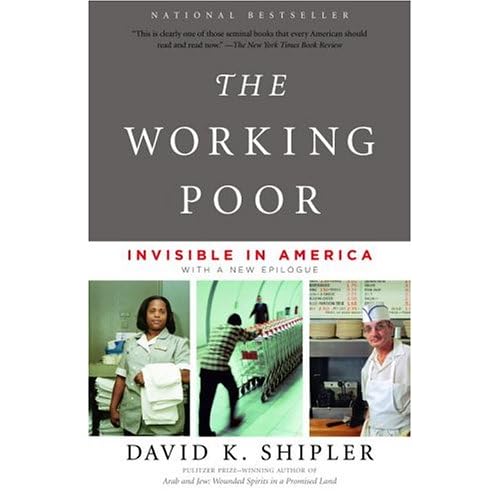
The first book, The Working Poor, starts off with the line "Nobody who works hard should be poor in America." It's a pretty bold statement, and I'm anxious to see if the author can back it up. The other book is called Gig, and it is a collection of interviews from people with jobs as various as porn star, carnie, and CEO. I read one from a highway worker (obviously I'd go there first) while I was still at the store, and it's pretty interesting. The interviewee is a woman, and now I'm wondering if Donny shouldn't be Donna, but I'm not sure I want to take on gender issues at the same time that I'm trying to deal with everything else. Should make for some interesting summer reading, though. Combine that with the job I'm hoping to get, and I will be in blue collar heaven over the summer. Back to my roots.
Back in the day, when I went against my parents' wishes, dropped out of Kent State, and moved in with my boyfriend (I was 19), I had a string of crappy jobs before I finally got hired at Westfield Insurance when I was 21. Those were the hardest two years of my life, but there was so much learning. I started out working third shift at Dairy Mart, selling coffee and chewing tobacco to the locals, and fighting with the drunks when they came in at 1:06 and wanted to buy another six-pack. They thought I was just being a bitch when I told them I couldn't sell it to them, but really, the computer on the register was set up so I couldn't ring up any alcohol after 1 a.m. (state law). I only lasted there a month, and when I gave my 2 weeks notice, the manager told me I was a snob and that I didn't have to come back for my next shift. Maybe I was a snob, but I didn't want to sell half-spoiled lunch meat to welfare moms anymore.
After that, I worked at a super 8 motel. Again, I was working 3rd shift (let me tell you, it is really hard to find a job with regular hours when you've got no education). This time, the highlight of the experience was having the cops banging on the door because I had fallen asleep behind the counter and they thought no one was there. Oh, and working with this woman who was charged with man-slaughter because her baby drowned in the bathtub. It was such a sad story, and she was such a sad woman.
Finally, I found the job at Ruby Tuesday that just about saved my life. For one thing, they had day one health insurance (a practice I think all minimum wage paying employers should use), for another, there was no limit on over time, so if I wanted to work 12 hours a day, every day, I could (and I did for the first summer), and finally, because I was surrounded by people who were going to college and they motivated me to get my life back on track. Eventually serving got old too, especially when the management changed and the food started getting bad, which meant the tips started getting bad. By that time, I had been back at school for 3 or 4 semesters and decided to start looking for a day job.
Even though that was five years ago, I still feel like I fit in better with the working class crowd than I do with the academics or the professionals. I can't really explain why...maybe it's because that's how I was raised; no formal dining rooms or fancy china, just good manners. Respect your elders, say please and thank you, hold the door open for the person behind you. Work hard, and when you're finished, play hard. My dad worked at Ford until he retired in '94 and as far as I can remember, he never took any over time because he wanted to be with the family. When I worked 9 to 5, I was out the door by 5:15 when everyone else was working until 6:30 or 7. Why? Because I was paid for 40 hours, and the rest of my life was more important than sucking up to the boss.
Academia is better because you're allowed (expected) to get the work done on your own schedule, so I don't feel like I'm tied to a desk 9 hours a day even though I'm probably working more than that most days. But I still feel like I'm...visiting. That's why I think sometimes I'll keep teaching part-time and working a second job because that allows me the flexibility that I crave and also allows me to straddle those two worlds which is somehow, a little more comfortable for me.
Well, I don't know where that all came from. I was expecting this to be a short blog. Anybody else want to weigh in on the working class/academia debate? I know there've been a lot of articles on it. Maybe I should read some.


the anxieties of blue skies
1 week ago


5 comments:
I think I disagree with the first line of that book. I have heard of that book. So, my thought is I work really hard to get straight-A's...shouldn't I get paid to do that? I work really, really hard in my yard, should that constitue my being kept out of the poor-house? I don't think anyone should expect to be able to live off of low-wage jobs. If you want to earn a living, then that is another thing altogether...but that is the Republcan in me coming out and I better shut up about that right now.
I have had similar work and school experiences as you. I got married right out of high school, attmepted college right away, quit right away, worked really boring jobs for a few years, then decided I better get a college degree after all. I never could have come to this decision without having gone through the learning experience of those few years...and I'm glad I did.
I have met few professors at my college that are actual down-to-earth people. I have liked almost all of them, but most of them are terribly insecure, trying to be something they're not, and want you to think that they have always been sucessful. So I'm with you on that...I was raised pretty middle class and don't aspire to be like that. The professors who have really inspired me are the ones that make me feel like they have been where I am. I really respect that.
I think you're taking the statement a bit too literally--or you're giving "work" too broad of a definition. Both the things you mentioned are luxuries, priveliges that the people Shipler's writing about don't often have. The fact that you're working really hard in your yard suggests that you have enough money and stability to own a home (or at least rent one with a lawn). You work really hard to get straight A's? That's great, and it is going to help you out in the future, allow you to get away from those really boring jobs of your past. But it's still something you get to do, not something that you have to do for survival.
The sad thing is that people are expected to live off those low-wage jobs (or two or three of them) and often don't have any other options. When I first moved out on my own, I worked 2 jobs, one paid 6.50 and the other paid 7, both about 30 to 35 hours a week, and I was barely able to pay for my $425 apartment, let alone fix my car if it broke down.
I was lucky...when I realized how bad I had fucked up, my mom and dad let me move back home and I spent the next six months saving every penny so I could pay off the bills I'd piled up over the last year. But most people don't have that option and instead of getting the chance to change their lives like I did, they just keep hopping from one shitty job to the next.
I don't allign myself with one political party or the other, and to be honest I can't debate the politics of it, but I know the reality, and even though I'm out of it (for now), I have family members who are very much struggling to make the system work for them. It's easy to say that hard work pays off, but it's a lot harder to see your own hard work amount to anything but a paltry pay-check when you're living hand to mouth.
And now I'll step off my soap-box.
Yes, I understand what your saying. My hard work at gardening is only valuable to me, so why would anyone want to pay me for that? But in the same manner, someone's hard work at McDonalds (for instance) is only worth so much. I'm not saying it isn't hard, and I really respect people who do more than one job, or students who work and go to school at the same time (many of my fellow students) but hard work in the right direction does pay off. In America, if you want to go to college or get some type of vocational training, and you don't have the money to do so, there is money out there to make that available.
And on another note, if you can't "make it" in America, you won't be able to make it anywhere.
Sara:
I think you really should look into getting a job at some hole-in-the-wall small town community college. You know, some school where there are about 2,000 students at most and way out of the way from anything. \
Right off the top of my head I am thinking places like College of Eastern Utah (in Price) or Snow College (in Ephraim, Utah). Now I don't mean those places specifically, but you should look them up to see what I mean.
I bet you would fit into those places teaching English and creative writing very well. Thos places cater to the non-traditional student and people who are particularly 'working class.'
Those kind of places are off the radar enough where nobody really is the academic type, yet you are still teaching. It may be for less money, but there is always the small town vibe and a very relaxed pace to compensate.
Check out those two to see what I am talking about. I know Ohio or the surrounding states must have a lot of small schools tucked away---hidden in far away corners.
That's not a bad idea, Justin. I'll look into it. Thanks!
Post a Comment